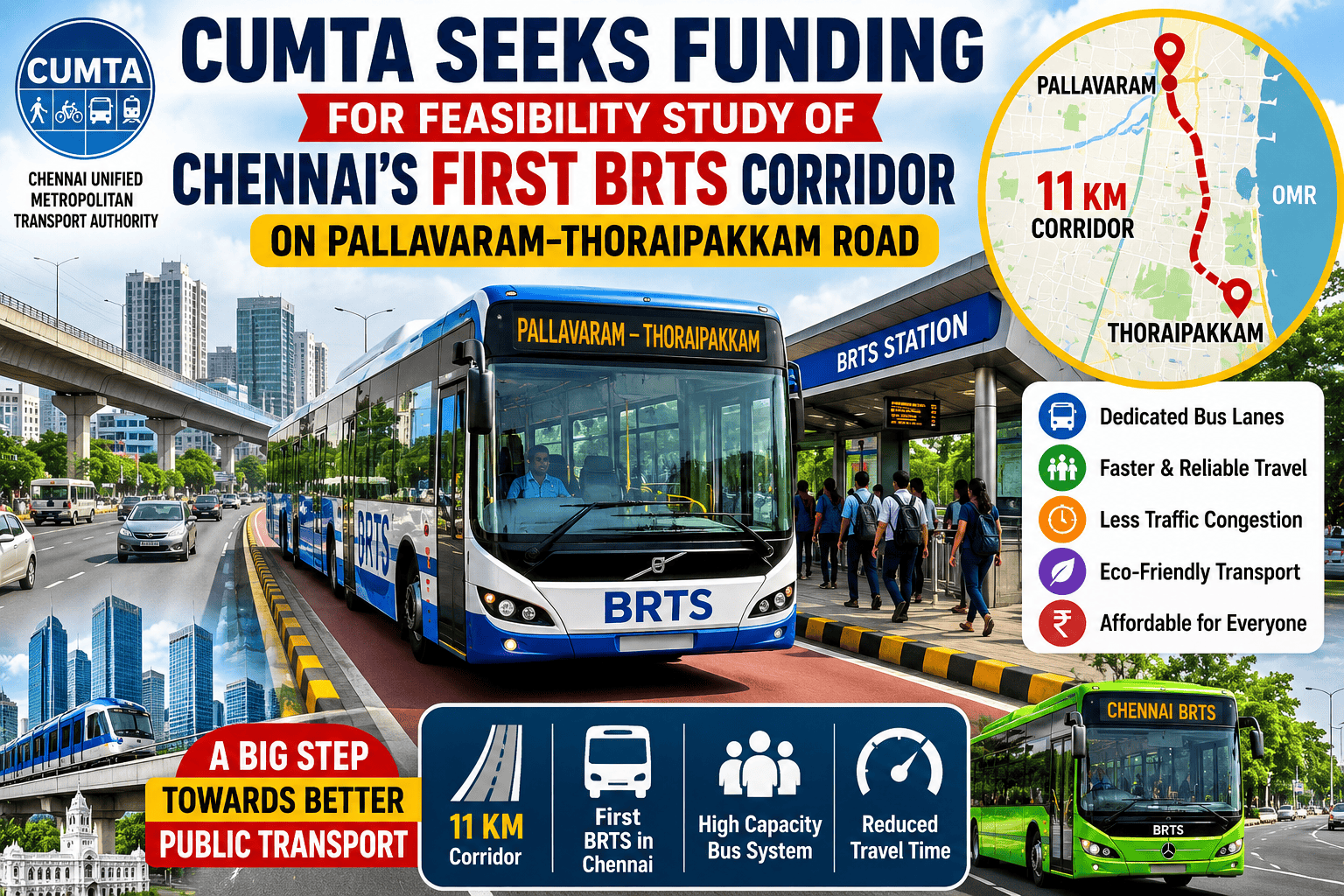
The Chennai Unified Metropolitan Transport Authority (CUMTA) has taken a significant step towards improving public transportation by seeking funding from the Tamil Nadu government to conduct a feasibility study for Chennai’s first Bus Rapid Transit System (BRTS) corridor. The proposed 11-kilometre corridor will run along the Pallavaram–Thoraipakkam Road (PTR), a key arterial road connecting GST Road with the city’s IT corridor on Old Mahabalipuram Road (OMR).
Why Pallavaram–Thoraipakkam Road?
According to transport officials, the Pallavaram–Thoraipakkam Road has been identified as the most suitable location because it offers a 60-metre-wide right of way, which is sufficient to accommodate dedicated BRT lanes while maintaining regular traffic lanes. Most major roads in Chennai lack the minimum width required for a full-scale BRT system, making this corridor a practical choice.
A Major Push for Bus-Based Public Transport
The proposal follows the Tamil Nadu government’s renewed focus on strengthening bus-based urban mobility. Officials have been directed to examine successful Bus Rapid Transit models, including those in South Korea, to improve the speed, reliability, and efficiency of Chennai’s public transport network.
If approved, the Pallavaram–Thoraipakkam corridor will serve as a pilot project. Authorities hope it can become a model for future BRT corridors across Chennai.
What is a Bus Rapid Transit System (BRTS)?
A Bus Rapid Transit System is a high-capacity public transport network that operates buses on dedicated lanes, reducing delays caused by mixed traffic. Modern BRT systems typically include:
- Exclusive bus lanes
- Level boarding stations
- Intelligent traffic signal priority
- Faster boarding and alighting
- Improved pedestrian access
- Reliable travel times
These features allow buses to operate with efficiency similar to metro rail systems but at a significantly lower construction cost.
Part of Chennai’s Long-Term Mobility Plan
The proposal aligns with CUMTA’s Comprehensive Mobility Plan (2023–2048), which recommends several BRT corridors across the Chennai Metropolitan Area. While an earlier proposal for a Broadway–Poonamallee BRT corridor faced challenges due to limited road width, the Pallavaram–Thoraipakkam Road offers more favourable conditions for implementation.
Benefits Expected from the Project
If implemented successfully, Chennai’s first BRTS corridor could deliver several benefits:
- Reduced travel time between Pallavaram and Thoraipakkam
- Faster and more reliable Metropolitan Transport Corporation (MTC) bus services
- Lower traffic congestion
- Reduced vehicle emissions
- Better connectivity between GST Road, OMR, and surrounding residential and IT hubs
- Affordable, high-capacity public transport for daily commuters
Challenges Ahead
Transport experts note that infrastructure alone will not guarantee success. Dedicated bus lanes must remain free from encroachment by private vehicles, and strong traffic enforcement will be essential. Experience from other Indian cities shows that effective lane discipline is one of the most critical factors in the success of BRT systems.
What’s Next?
The state government will first review CUMTA’s request for funding. Once approved, the feasibility study will assess technical, financial, environmental, and traffic-related aspects before a Detailed Project Report (DPR) is prepared.
If the project moves forward, it will mark Chennai’s first dedicated Bus Rapid Transit corridor and could pave the way for a modern, faster, and more sustainable public transport system across the city.
