Thomas Muller Referee Bias Claim Revives Debate Over 2010 World Cup Clash
The Thomas Muller Referee Bias Claim has reignited discussion about one of the most memorable matches of the 2010 FIFA World Cup. More than a decade after Germany defeated Argentina 4-0 in the quarterfinals, Bayern Munich legend Thomas Müller has shared his thoughts on a controversial refereeing decision that changed his own tournament.
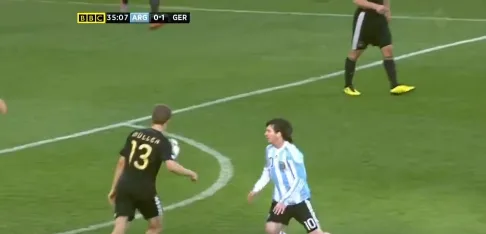
Speaking in a recent interview, Müller recalled receiving a yellow card after the ball struck his arm near Lionel Messi during the match. The booking meant the young German midfielder was suspended for the semifinal against Spain. The Thomas Müller Referee Bias Claim centers on his belief that the referee treated Messi differently after an earlier incident involving the Argentine star.
Although the match itself ended in Germany’s favor, Müller’s comments have reopened conversations about refereeing consistency, player treatment, and football’s biggest debates.
Thomas Müller Referee Bias Claim Focuses on a Costly Yellow Card
Germany entered the 2010 World Cup quarterfinal full of confidence after an impressive tournament.
The team produced one of its finest performances by defeating Argentina 4-0 in Cape Town. Müller played a major role in the victory and even scored the opening goal.
However, the match also brought personal disappointment.
During the first half, the ball struck Müller’s arm after a challenge involving Lionel Messi. The referee judged the incident as a handball and showed Müller a yellow card.
Because he had already received a booking earlier in the tournament, the caution triggered an automatic suspension for the semifinal against Spain.
Looking back, Müller believes the decision had a significant impact on his World Cup journey.
Müller Believes Messi Was Treated Differently
The heart of the Thomas Müller Referee Bias Claim is not simply the yellow card itself.
Instead, Müller questioned why Messi escaped punishment after an earlier handball incident during the same match.
According to Müller, both situations deserved similar treatment. He suggested the referee showed greater leniency toward Messi while taking a stricter approach with him.
However, he also acknowledged that refereeing decisions happen quickly and can be difficult in high-pressure matches.
His comments reflect frustration over losing the chance to play in one of football’s biggest games rather than personal criticism of Messi.
That distinction has become important as fans continue discussing the interview.
Missing the Spain Semifinal Remains a Painful Memory
Germany’s victory over Argentina was one of the team’s greatest World Cup performances.
Unfortunately for Müller, he could not help his teammates in the next match.
Germany lost 1-0 to Spain in the semifinal after a tightly contested encounter.
Many supporters have long wondered whether Müller’s presence might have made a difference.
At just 20 years old, he had already become one of Germany’s most dangerous attacking players during the tournament.
His energy, movement, and goal-scoring ability were key reasons behind Germany’s impressive campaign.
Therefore, missing the semifinal remains one of the biggest disappointments of his international career.
Fans Remain Divided Over the Controversy
As expected, Müller’s comments quickly sparked debate among football supporters.
Some fans agreed with his assessment and argued that referees have occasionally shown inconsistency when dealing with football’s biggest stars.
Others defended the original decisions, saying each incident should be judged on its own merits rather than compared directly.
Several supporters also pointed out that refereeing standards have changed significantly since 2010.
Today, the Video Assistant Referee (VAR) provides officials with additional reviews that were unavailable during that World Cup.
Many believe modern technology could have reduced the controversy surrounding both incidents.
The Match Remains One of Germany’s Greatest Performances
Despite the renewed debate, Germany’s performance against Argentina remains unforgettable.
Joachim Löw’s side combined disciplined defending with fast counterattacking football.
Müller opened the scoring before Miroslav Klose, Arne Friedrich, and Klose again completed the remarkable victory.
Argentina struggled to contain Germany’s pace and movement throughout the match.
Lionel Messi, already one of the world’s best players, found few opportunities to influence the game against Germany’s organized defense.
Even today, many analysts consider the performance one of Germany’s finest World Cup displays.
Refereeing Decisions Continue to Shape Football History
Football history is filled with moments where refereeing decisions changed tournaments.
Some decisions become forgotten within weeks.
Others remain topics of discussion for decades.
Müller’s latest interview shows how deeply certain moments stay with players long after retirement approaches.
Every yellow card, penalty, or offside decision can influence careers, championships, and sporting history.
However, football also continues to evolve.
VAR, improved referee training, and greater transparency have reduced some controversies, although debates still occur regularly.
Perfect consistency remains difficult because every match presents unique situations.
Why This Story Still Matters Today
The interview has also renewed discussion around Lionel Messi’s remarkable career.
Whenever former opponents share memories involving Messi, public attention quickly follows.
Some supporters view Müller’s comments as an honest reflection on an unfortunate moment.
Others believe the referee simply made the best decision possible under pressure.
Regardless of opinion, the conversation highlights how football’s greatest players remain connected through memorable matches.
It also explains why discussions surrounding the World Cup and the sport’s greatest players continue years after the final whistle.
