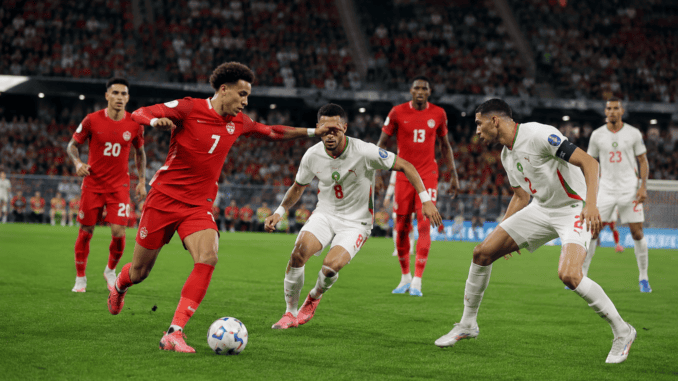
Canada vs Morocco Half-Time Analysis
The Canada vs Morocco Half-Time Analysis tells the story of a fiercely competitive FIFA World Cup 2026 Round of 16 encounter that remains delicately poised after an entertaining opening 45 minutes at NRG Stadium in Houston. With the score locked at 0-0, neither side has managed to produce the decisive breakthrough, but the first half has been packed with tactical intrigue, physical battles, and moments that suggest an exciting second half awaits.
Morocco entered the knockout fixture as the higher-ranked nation and one of the tournament’s strongest defensive teams, while Canada arrived eager to continue their impressive World Cup campaign under Jesse Marsch. Both sides understood that a single mistake could end their hopes of progressing to the quarter-finals, resulting in a disciplined and cautious opening period.
Despite the lack of goals, the match has delivered plenty of intensity. Midfield battles, strong defensive organization, and several yellow cards have highlighted the importance of the occasion, with both teams refusing to give their opponents any easy opportunities.
First Half Overview
Canada lined up in a traditional 4-4-2 formation, looking to stretch Morocco with quick transitions through Jonathan David and Tani Oluwaseyi. Stephen Eustaquio dictated much of Canada’s tempo from midfield, while Ali Ahmed and Tajon Buchanan worked tirelessly on the flanks to support attacks and recover possession.
Morocco adopted their familiar 4-2-3-1 system, relying on Achraf Hakimi and Noussair Mazraoui to provide width from full-back while Brahim Díaz looked to create space between Canada’s midfield and defence.
The opening exchanges were played at a high tempo, with Canada pressing aggressively and forcing Morocco to play quicker than they would have preferred. As the half progressed, Morocco settled into longer spells of possession, but Canada’s compact defensive lines prevented the Atlas Lions from creating many clear-cut scoring opportunities.
Neither goalkeeper faced constant pressure, reflecting the disciplined defensive performances produced by both teams. Canada remained compact whenever Morocco entered the final third, while Morocco successfully limited Jonathan David’s influence by crowding the Canadian striker whenever he received possession.
Key Moments Before Half-Time
The first major turning point arrived in the 22nd minute when Morocco were forced into an early substitution after Ismael Saibari was unable to continue. Soufiane Rahimi entered the contest, giving Morocco fresh attacking energy but also forcing an unexpected tactical adjustment.
As the match became increasingly physical, referee Michael Oliver was called upon repeatedly to calm tempers. Several robust challenges resulted in bookings, underlining the intensity of this World Cup knockout contest.
Jonathan David received a yellow card after a late challenge shortly before the break, while Azzedine Ounahi was also cautioned during added time following another strong tackle. Earlier in the half, Redouane Halhal, Richie Laryea, and Achraf Hakimi had also entered the referee’s notebook after separate incidents.
Six minutes of added time reflected the stoppages caused by injuries, disciplinary issues, and treatment on the field. Although both teams continued searching for an opening goal, the deadlock remained intact as the whistle signalled the end of the first half.
Tactical Analysis
Canada’s tactical discipline has arguably been their biggest strength so far. Jesse Marsch’s side has remained organized without the ball, defending in compact lines and forcing Morocco into wide areas where crosses have been comfortably dealt with by the Canadian central defenders.
Morocco have controlled longer periods of possession, but their attacking combinations have lacked the final pass needed to unlock Canada’s defensive structure. Brahim Díaz has drifted into dangerous pockets of space, while Hakimi has frequently advanced down the right flank, yet Canada have largely neutralized these threats.
The midfield contest has been particularly important. Stephen Eustaquio has helped Canada remain composed under pressure, while Morocco’s Azzedine Ounahi and Neil El Aynaoui have attempted to dictate possession through patient passing.
Canada’s counter-attacking approach remains their greatest opportunity in the second half, whereas Morocco may need greater movement between the lines to create higher-quality chances.
Standout Players
Canada have produced several impressive individual performances during the opening 45 minutes.
Tani Oluwaseyi has worked tirelessly up front, pressing Morocco’s defenders and providing an outlet whenever Canada have won possession. Stephen Eustaquio has demonstrated excellent positional awareness, breaking up attacks while distributing the ball efficiently.
Ali Ahmed has offered pace and creativity from midfield, helping Canada transition quickly whenever opportunities have appeared.
For Morocco, Achraf Hakimi has again shown his quality by contributing both defensively and offensively despite receiving a booking. Noussair Mazraoui has provided balance on the opposite flank, while goalkeeper Yassine Bounou has remained composed whenever called into action.
Although neither goalkeeper has been forced into a series of spectacular saves, both have inspired confidence behind disciplined defensive units.
Discipline and Match Intensity
The opening half has been fiercely contested, with several physical duels highlighting the importance of the occasion.
Five yellow cards have already been shown, reflecting the aggressive nature of challenges from both teams. Michael Oliver has maintained firm control throughout, ensuring that the contest has remained competitive without becoming overly reckless.
Both managers will now face an important decision. Players already carrying bookings may need to approach challenges more cautiously during the second half to avoid suspensions or dismissals.
What to Expect in the Second Half
The second half promises to become more open as fatigue creates additional space across the pitch.
Canada will continue looking for quick counter-attacks through Jonathan David and Tajon Buchanan, while Morocco are expected to increase attacking pressure by involving Brahim Díaz and Soufiane Rahimi more frequently around the penalty area.
Substitutions could prove decisive, particularly as both benches include experienced players capable of changing the rhythm of the contest.
With a place in the FIFA World Cup quarter-finals at stake, neither team will want extra time if they can avoid it, meaning attacking intent is likely to increase after the restart.
Half-Time Verdict
The Canada vs Morocco Half-Time Analysis highlights a fascinating tactical contest between two well-drilled teams. Canada have impressed with disciplined defending, intelligent pressing, and dangerous counter-attacks, while Morocco have demonstrated patience, technical quality, and composure in possession.
Although the scoreboard still reads 0-0, the match feels finely balanced. A single moment of quality, a tactical adjustment, or an impact substitution could determine which nation secures a place in the FIFA World Cup 2026 quarter-finals. Supporters can expect an intriguing and hard-fought second half as both teams continue their pursuit of World Cup glory.
Match Statistics (Half-Time)
| Statistic | Canada | Morocco |
|---|---|---|
| Half-Time Score | 0 | 0 |
| Formation | 4-4-2 | 4-2-3-1 |
| Yellow Cards | 2 | 3 |
| Red Cards | 0 | 0 |
| Substitutions | 0 | 1 |
| Added Time | 6 mins | 6 mins |
| Referee | Michael Oliver | Michael Oliver |
| Venue | NRG Stadium, Houston | NRG Stadium, Houston |
Key Takeaways
- Canada frustrated Morocco with a disciplined defensive performance in the first half.
- Morocco enjoyed promising attacking moments but failed to create a decisive breakthrough.
- The match became increasingly physical, resulting in five yellow cards before half-time.
- Morocco were forced into an early substitution after Ismael Saibari left the field through injury.
- The second half remains finely balanced, with tactical adjustments likely to decide the outcome.
Frequently Asked Questions (FAQ)
What is the half-time score between Canada and Morocco?
The match is level at 0-0 at half-time in the FIFA World Cup 2026 Round of 16.
Where is Canada vs Morocco being played?
The match is taking place at NRG Stadium in Houston, United States.
Which competition is Canada vs Morocco part of?
The fixture is part of the FIFA World Cup 2026 Round of 16.
Why was Soufiane Rahimi introduced early?
Rahimi replaced Ismael Saibari after Saibari was forced off with an injury in the first half.
Who has impressed during the first half?
Stephen Eustaquio, Tani Oluwaseyi, Achraf Hakimi, Noussair Mazraoui, and Yassine Bounou have all delivered solid performances.
