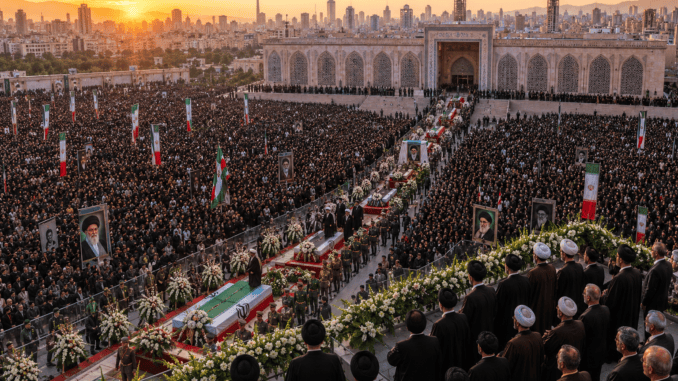
Iran’s state funeral for former Supreme Leader Ayatollah Ali Khamenei has drawn global attention—not only because of the scale of the ceremonies but also due to the absence of his successor, Mojtaba Khamenei.
While three of Ali Khamenei’s sons—Mostafa, Meysam, and Masoud—were seen offering funeral prayers beside their father’s coffin in Tehran, Mojtaba, who succeeded him as Iran’s Supreme Leader, did not make a public appearance. His absence has fueled widespread speculation, although Iranian officials have attributed it to heightened security concerns.
State Funeral Draws Massive Crowds
The funeral ceremonies began at Tehran’s Imam Khomeini Grand Mosalla, where thousands of mourners gathered to pay their respects.
Television broadcasts showed Ali Khamenei’s coffin alongside those of several family members who were also killed in the February attack. Senior Iranian officials, military commanders, clerics, and foreign dignitaries attended the event as part of a week-long state mourning program. Funeral processions are also planned in several religious cities, including locations in Iraq, before the final burial.
Three Sons Attend, But Mojtaba Is Missing
During the funeral prayers, Mostafa Khamenei, Meysam Khamenei, and Masoud Khamenei stood behind the coffins alongside senior Iranian leaders.
However, Mojtaba Khamenei, who became Iran’s Supreme Leader following his father’s death earlier this year, was absent from the public ceremony.
His absence immediately became one of the biggest talking points surrounding the funeral, with social media users and international observers questioning why the country’s highest-ranking leader did not attend such a significant national event.
Why Didn’t Mojtaba Khamenei Attend?
According to Iranian officials, Mojtaba Khamenei stayed away because of extraordinary security risks.
Authorities reportedly believe that any public appearance could expose him to potential attacks amid continuing tensions with Israel and the broader regional security situation.
Iranian representatives have stated that protecting the country’s new Supreme Leader remains the government’s highest priority, particularly after the attack that killed Ali Khamenei and several members of his family.
Reports of Earlier Injuries
Multiple media reports have indicated that Mojtaba Khamenei was injured during the February strike that killed his father.
Reuters reported that people close to his circle said he suffered facial injuries and significant leg injuries, although Iranian authorities have not publicly released detailed medical information or recent images confirming his condition.
Because of the limited official information, speculation about his health has continued online. However, there has been no official confirmation from Iranian authorities that he has died.
Rumors Continue to Circulate
Mojtaba’s absence has fueled rumors across social media regarding his health and whereabouts.
Despite these claims, Iranian officials continue to maintain that he remains the country’s Supreme Leader and that his absence from public events is driven by security considerations rather than any confirmed change in his status.
Donald Trump’s Comments
The funeral also became part of the broader geopolitical discussion after U.S. President Donald Trump commented on the temporary pause in negotiations with Iran.
Speaking during an event marking America’s 250th anniversary celebrations, Trump said the United States had delayed talks for a week to allow the funeral ceremonies to take place.
His remarks added another layer to already tense relations between Washington and Tehran, where negotiations remain uncertain following months of conflict.
A Symbolic Political Event
Beyond honoring Iran’s former leader, the funeral serves as an important political event for the Islamic Republic.
Large public gatherings, religious ceremonies, and official processions are intended to demonstrate national unity and reinforce support for the country’s leadership during a period of heightened regional tensions.
Observers also view the funeral as an opportunity for Iran’s leadership to project stability following the transition of power.
What’s Next?
The official mourning ceremonies are expected to continue for several days, with processions planned across multiple cities before Ali Khamenei’s final burial.
Whether Mojtaba Khamenei will make a public appearance during the remaining ceremonies remains unclear.
For now, Iranian authorities continue to emphasize security precautions while the world closely watches developments surrounding the country’s new leadership.
Final Thoughts
Mojtaba Khamenei’s absence from his father’s funeral has attracted worldwide attention and sparked considerable speculation. While online rumors continue to circulate, Iranian officials insist that security threats are the primary reason he has remained out of public view. As funeral ceremonies continue across Iran and neighboring Iraq, attention will remain focused on whether the new Supreme Leader appears publicly and how Iran navigates its next phase of political leadership.